Centennial houses generally have attached garages that are straightforward to coat, with flake as the daily-driver system. After a south-metro hail day those garages also hold extra cars and a lot of grit. A sealed floor is when that week stays tolerable.
Office-suite floors near the Tech Center are not this residential spec. If that is the job, say so and name the after-hours rule.
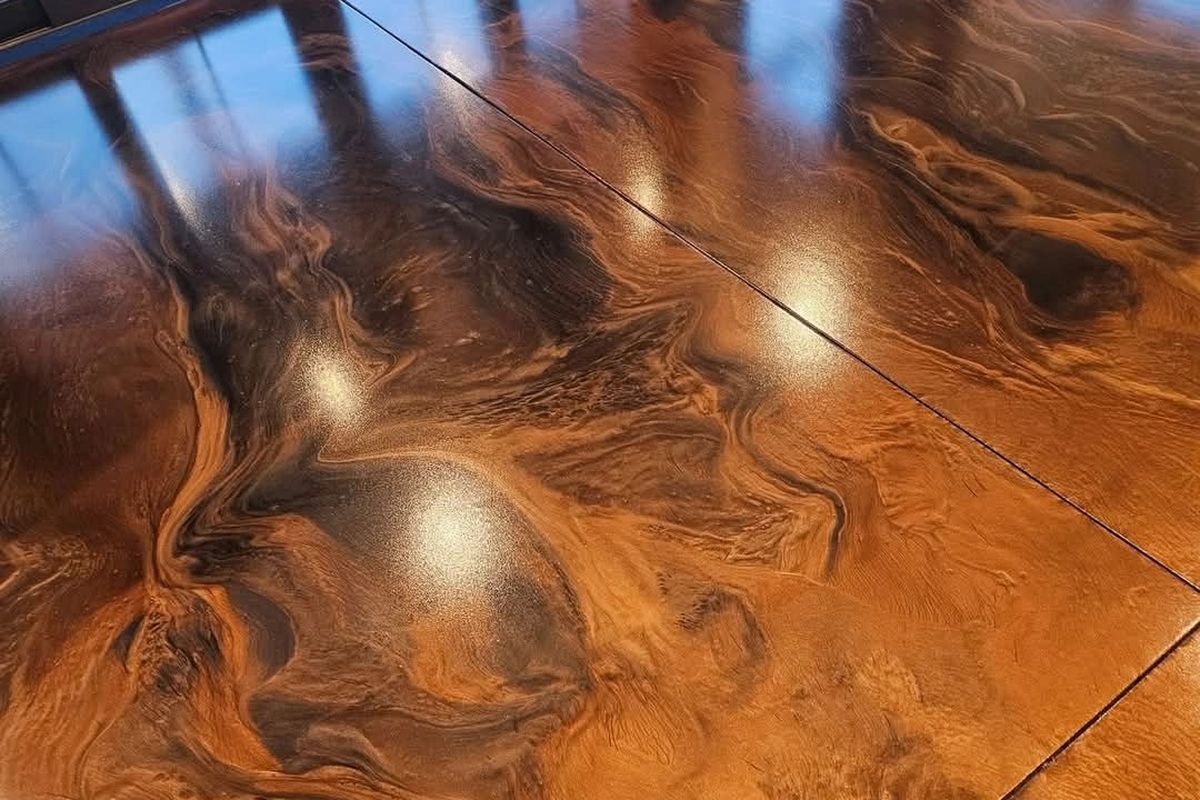
The photo is an example finish, not a documented Centennial job.
Before a coating is chosen, the concrete needs to be checked for moisture and surface condition. A slab can look dry while moisture vapor still moves through it. Calcium chloride testing measures moisture emission at the surface; in-situ relative-humidity testing checks conditions within the slab. Results help determine whether the proposed system is suitable or whether more investigation is needed.
A sound coating bond depends on a prepared concrete profile. Diamond grinding removes weak material and opens the surface to a consistent texture, often described by a concrete surface profile, or CSP. Acid etching is not an equivalent shortcut: it may leave an uneven surface or residue, and it does not remove failing coatings or repair weak concrete. Ask how the installer will verify the prepared slab before coating.
Cracks and control joints need separate decisions. A stable crack may be repaired before the primer and base coat, while a moving joint generally needs to remain able to move rather than being rigidly covered. Ask which defects will be filled, which will be honored through the finish, and whether the repair will remain visible. That conversation is better before flakes and topcoat conceal the slab.
For an attached garage, ask what each layer is intended to do. The primer supports adhesion to the prepared slab, the base coat holds the flake broadcast, and the topcoat protects the finished surface. Full flake coverage can help disguise ordinary dust and visual variation, but the installer should explain how the finish is sealed and how texture will affect cleaning and traction.
Epoxy, polyaspartic, and polyurea describe different coating chemistries, not a guarantee of performance by themselves. Compare the complete system, including prep, primer, film build, topcoat, and the stated limits for concrete and air temperature and humidity. A fast cure can shorten downtime, but it also leaves less working time; the crew must be able to apply the material within its specified window.
A basement has different demands from a garage. First check for moisture and consider whether the room is suitable for a coating system at all; a coating does not correct water entering through walls or a slab. For a business or office-suite floor near the Tech Center, discuss access, ventilation, downtime, and the site’s after-hours requirements before choosing a finish. UV exposure also matters: ask whether the topcoat is UV-stable and how the system may change color over time.
Yes, particularly if the slab has a history of dampness, has recently been poured, or will receive a moisture-sensitive system. Ask which test method will be used, where readings will be taken, and how the results affect the coating recommendation. A visual inspection alone cannot measure moisture vapor movement.
No. Repairs can improve appearance, but concrete can continue to move and a repaired line may remain visible or reappear. Control joints are there to manage movement and are often treated differently from cracks. Ask the contractor to mark those locations and explain the repair approach before work starts.
Ask for the minimum and maximum substrate and air temperatures for the specified system, along with its humidity limits. The concrete needs to meet those conditions during application and curing, not just when the crew arrives. If the slab is too cold or damp, postponing work is safer than rushing the coat.
Ask to see or feel a sample with the proposed texture and topcoat. More texture can improve grip, but it may also hold dirt and take more effort to clean. Discuss the room’s likely water, grit, and footwear conditions, then agree on a finish that balances traction with maintenance.
Get separate return-to-service times for foot traffic and vehicles. The surface may feel hard before the coating has reached the cure needed for tires, and hot tires can pull up an under-cured finish. Follow the installer’s written cure instructions and keep vehicles, stored items, and cleaning water off until allowed.
Tell us about the floor in Centennial. A photo and a rough size are enough to start a written estimate. No street address on our side — local pros come to the slab.
Denver Epoxy Floors is an independent referral service that connects you with local epoxy flooring pros.
 DENVER